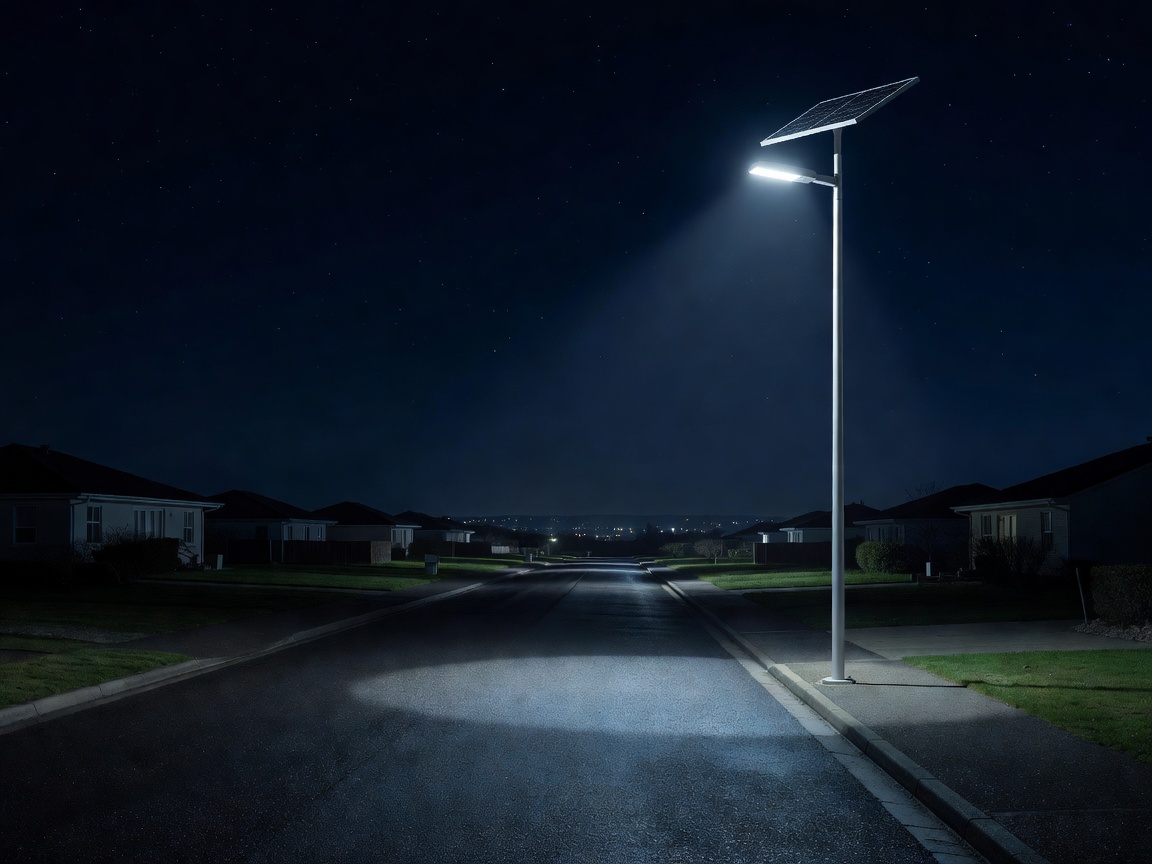
When illuminating expansive spaces like public roadways, commercial parking lots, vast residential associations, and farm properties, traditional grid-tied streetlights represent a massive investment in trenching, cabling, and ongoing monthly electrical bills. Commercial-grade solar powered street lights bypass these massive infrastructure hurdles, delivering reliable, high-output illumination that practically pays for itself over time.
Anatomy of a Commercial Solar Street Light
Unlike small residential pathway lights, commercial solar street lights are heavy-duty engineering marvels. They are broadly categorized into two types: All-in-One (Integrated) and Split Type.
All-in-One Units: These house the solar panel, LED array, lithium battery, and smart controller in a single, sleek casing. They are aerodynamically designed to withstand high wind loads and are incredibly simple to mount onto existing poles.
Split Type Systems: These separate the LED head, the battery box, and the solar panel. While they require more complex assembly, they allow for massive solar panels and heavy battery banks that can ensure multiple days of autonomy (the ability to stay lit during consecutive overcast days).
Key Technologies and Specifications
1. The Shift to LiFePO4 Batteries
The biggest leap in solar street lighting technology has been the widespread adoption of Lithium Iron Phosphate (LiFePO4) batteries. Compared to old lead-acid or standard lithium-ion batteries, LiFePO4 cells handle extreme temperature fluctuations brilliantly and offer thousands of charge cycles. This pushes the maintenance requirement from every 2 years out to 5-8 years, massively reducing municipal maintenance costs.
2. Smart Charge Controllers and Dimming
To maximize battery life and ensure lights stay on until dawn, commercial units utilize smart PWM (Pulse Width Modulation) or MPPT (Maximum Power Point Tracking) charge controllers. Furthermore, most systems operate on a timed dimming schedule. For example, the light may operate at 100% brightness from dusk until midnight, and then drop to 30% brightness until a built-in motion sensor detects movement, at which point it ramps back up to 100%.
3. Massive Lumen Outputs
For street safety, minimal lighting won't cut it. Entry-level commercial solar lights start at around 3,000 to 5,000 lumens, while heavy-duty roadway lights can output 10,000 to 15,000 lumens. These require highly efficient LED chips (such as Philips or Bridgelux) combined with specialized optical lenses that push the light outward into a wide, rectangular footprint (Type III or Type IV distribution) rather than a simple downward circle.
Pros and Cons
- Pros: Zero ongoing electrical costs; immune to rolling blackouts and grid failures; requires no invasive trenching; massive reduction in carbon footprint.
- Cons: High initial purchase price per unit; very heavy, requiring sturdy, specialized mounting poles; large panels are susceptible to heavy snow accumulation in extreme northern climates.
Installation Considerations
The mounting height is critical. A 50-watt, 5,000-lumen unit should typically be mounted between 13 to 16 feet high. A 100-watt, 10,000-lumen unit needs to be mounted higher, usually between 20 to 26 feet, to prevent blinding glare to drivers and to maximize the light spread on the pavement below.